
ADHD and Perfectionism: Why So Many Women Feel They Have to Work Twice as Hard

What Does Perfectionism Really Look Like?
You spend 20 minutes rewriting an email before sending it.
You stay back at work to "just finish one more thing," even though everyone else has already gone home.
You make endless lists, double-check your calendar, reread reports multiple times and still worry you've forgotten something important.
From the outside, you appear organised, capable and successful.
Inside, you feel like you're constantly trying to keep up.
If this sounds familiar, you're not alone.
Many women describe feeling as though they have to work twice as hard as everyone else simply to stay on top of everyday life. They often believe they're perfectionists, overly anxious, or simply not organised enough. For some, however, these perfectionistic behaviours may be doing something else entirely—they may be compensating for underlying Attention-Deficit/Hyperactivity Disorder (ADHD).
Perfectionism isn't part of the diagnostic criteria for ADHD, but it is something I see frequently in women who are diagnosed later in life. After years of missing deadlines, forgetting things, feeling disorganised or being criticised for being "careless," many women develop ways of preventing those mistakes from happening again.
Those strategies often work. They help women succeed at university, build careers, raise families and appear as though they have everything under control.
The problem is that they can also become exhausting.
Perfectionism Doesn't Always Look Like Perfection
When most people hear the word perfectionism, they imagine someone with immaculate handwriting, colour-coded planners and exceptionally high standards.
In reality, perfectionism is much more complex.
At its core, perfectionism involves an intense fear of making mistakes, disappointing others or not meeting impossibly high expectations. Rather than simply striving to do well, many perfectionists feel that anything less than perfect is unacceptable.
For women with ADHD, perfectionism often doesn't look like perfection at all.
Instead, it may look like:
Spending far longer on tasks than necessary because you're worried you've missed something.
Rewriting emails several times before pressing send.
Checking your calendar repeatedly because you're afraid you've forgotten an appointment.
Avoiding starting important tasks because they feel overwhelming or you don't think you'll do them well enough.
Procrastinating until the last minute, then working intensely to complete everything perfectly.
Feeling unable to relax because there's always "one more thing" you should be doing.
Becoming highly self-critical after even minor mistakes.
Many women describe feeling trapped in an exhausting cycle of over-preparing, overthinking and overworking.
One pattern I often explain to clients is that perfectionism tends to become self-reinforcing. The harder you work to prevent mistakes, the more mentally exhausted you become. As that mental fatigue builds, executive functioning often becomes even more difficult, reinforcing the belief that you simply need to try harder.
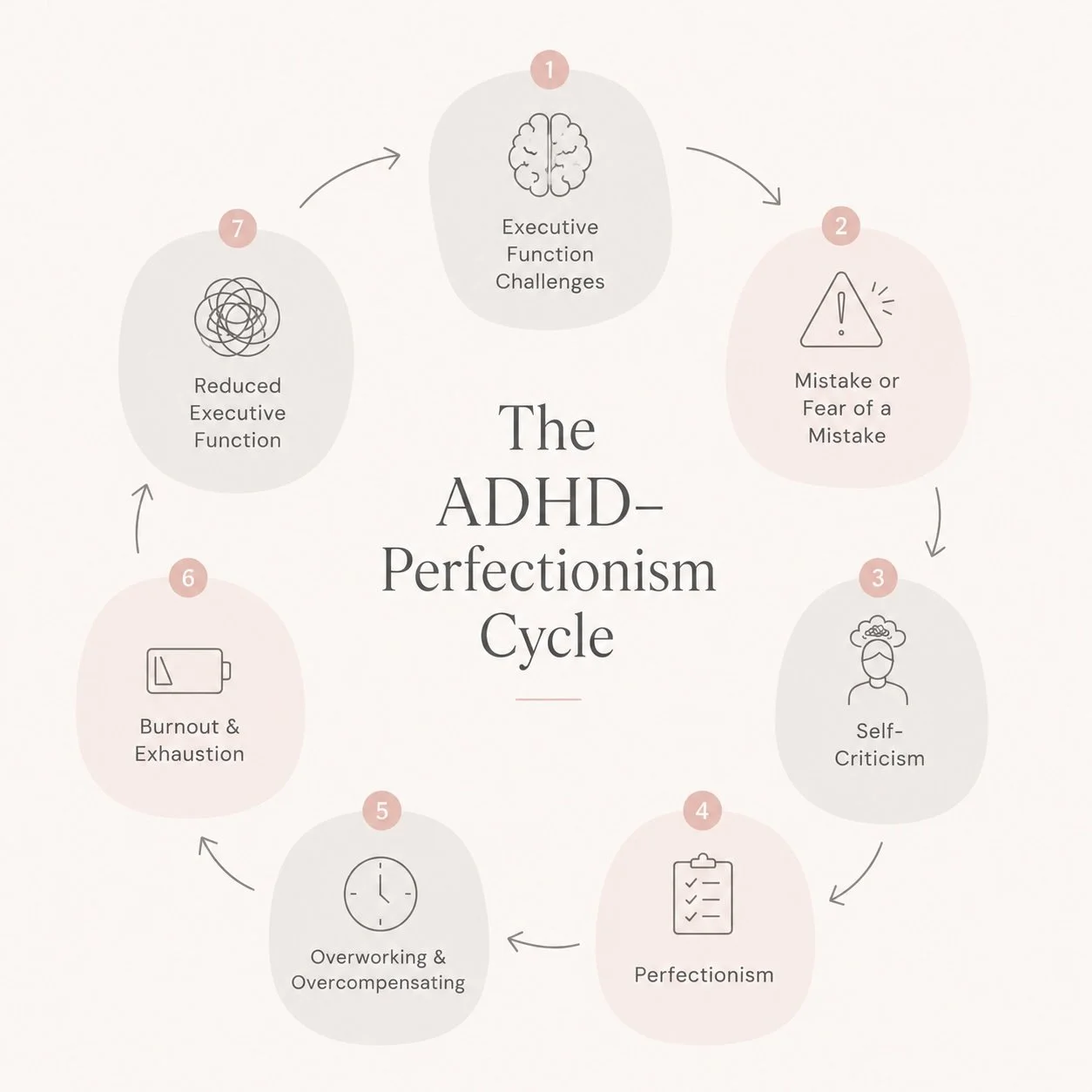
How ADHD and Perfectionism Can Reinforce Each Other.
Understanding this cycle can be incredibly validating because it helps explain why effort alone doesn't always solve the problem.
Ironically, these behaviours are often interpreted by others as evidence that they are highly organised or exceptionally conscientious. The reality, however, may be that enormous mental effort is required simply to keep everyday life running smoothly.
This distinction is important because perfectionism isn't always about wanting to be the best. Sometimes it's about trying desperately to avoid feeling like you've failed.
Is Perfectionism Part of ADHD?
One of the most common questions people ask is whether perfectionism is actually a symptom of ADHD.
The short answer is no.
Perfectionism is not one of the diagnostic criteria for ADHD in the Diagnostic and Statistical Manual of Mental Disorders (DSM-5-TR). However, many adults with ADHD—particularly women—describe experiencing perfectionistic thinking and behaviours throughout their lives.
For women with ADHD, it can look like:
Spending much longer on tasks than other people because you keep checking your work.
Rewriting emails before pressing send.
Reading reports over and over because you're worried you've missed something.
Avoiding starting a task because it feels too overwhelming.
Procrastinating until the deadline, then working intensely to produce something that feels "good enough."
Feeling like you can never truly relax because there's always one more thing to do.
Being incredibly hard on yourself after even a small mistake.
Many women don't recognise these as perfectionism.
They simply think they're being responsible.
So why does this happen?
One explanation is that perfectionism develops as a coping strategy.
Many people with ADHD experience executive functioning challenges that make everyday tasks more difficult. These can include difficulties with planning, organisation, working memory, time management, prioritising tasks and maintaining attention.
Over time, repeated experiences of forgetting important tasks, making careless mistakes, missing deadlines or receiving criticism can shape the way someone approaches future situations.
They may begin to think:
"I need to check everything twice."
"If I don't work harder than everyone else, I'll make a mistake."
"I can't let anyone see that I'm struggling."
"If I prepare for every possible scenario, maybe nothing will go wrong."
These strategies often work—at least initially.
Double-checking reduces mistakes.
Staying late at work helps compensate for losing focus during the day.
Spending hours preparing for meetings reduces the fear of forgetting something important.
The problem is that these strategies require an enormous amount of mental energy.
Rather than making life easier, they often lead to chronic stress, anxiety and burnout.
For many women, perfectionism becomes less about achieving excellence and more about protecting themselves from the possibility of failure, criticism or feeling "not good enough."
This is one reason why ADHD can remain undiagnosed for years. From the outside, everything appears to be under control. Behind the scenes, however, maintaining that appearance may require constant effort, leaving women feeling exhausted, overwhelmed and wondering why life seems so much harder for them than it does for everyone else.
What Does ADHD Perfectionism Actually Look Like?
Perfectionism doesn't always mean producing perfect work.
In fact, one of the greatest misconceptions about perfectionism is that it always leads to high performance.
Sometimes, perfectionism gets in the way of getting started at all.
Women with ADHD often describe experiences such as:
Spending far longer on tasks than other people
You tell yourself you'll spend ten minutes replying to emails.
An hour later, you're still editing the wording of the first one.
Every sentence feels as though it needs to be exactly right before you can press send.
Procrastinating because the standard feels impossible
Many people assume procrastination reflects laziness or poor motivation.
For some women with ADHD, however, procrastination develops because the pressure to do something perfectly becomes overwhelming.
If it can't be done "properly," it may feel safer not to start at all.
Feeling like you're constantly behind
Despite working incredibly hard, many women feel as though they're always catching up.
Simple tasks take longer than expected.
Unexpected interruptions throw the whole day off.
By the evening, there's still a long list of unfinished jobs, leading to guilt and the feeling that they should keep working.
Constantly second-guessing yourself
Questions such as:
"Did I say the wrong thing?"
"Did I forget something?"
"Should I check that email one more time?"
can become part of everyday life.
Although reassurance may help temporarily, the uncertainty often returns quickly.
Finding it difficult to switch off
Many women describe lying awake mentally reviewing conversations, replaying mistakes or thinking about tomorrow's tasks.
Their body may be at home, but their brain is still at work.
Over time, this constant mental effort contributes to fatigue, reduced concentration and emotional exhaustion.
Why Is Perfectionism So Common in Women with ADHD?
Although perfectionism can affect anyone, it is particularly common among women with ADHD.
One reason is that girls and women are often socialised differently to boys. From a young age, many girls are expected to be organised, responsible, emotionally aware and considerate of others. As a result, ADHD symptoms may look very different from the stereotypical image of a hyperactive young boy who struggles to sit still in class.
Instead of acting out, many girls quietly work harder.
They stay up later to finish assignments.
They rewrite homework until it feels "good enough."
They become the student who never forgets an assignment—not because organisation comes naturally, but because they've developed elaborate systems to stop themselves forgetting.
Over time, these strategies can become so ingrained that they no longer feel like coping mechanisms. They simply become part of who they are.
Many women describe feeling as though they have spent their entire lives trying to prevent mistakes before they happen.
They may:
Arrive excessively early because they're terrified of being late.
Triple-check appointments because they're worried they'll forget.
Over-prepare for meetings because they fear being caught off guard.
Say "yes" to extra work because they don't want others to think they're incapable.
Spend hours researching decisions because they're afraid of making the wrong choice.
To others, these behaviours often look like conscientiousness.
Internally, however, they may be driven by anxiety, fear of criticism, or years of trying to compensate for difficulties that were never recognised as ADHD.
This is one reason ADHD is frequently overlooked in women.
Rather than appearing disorganised or impulsive, many women become exceptionally skilled at hiding their struggles—a process psychologists often refer to as masking. This is the process of consciously or unconsciously compensating for ADHD-related challenges in order to meet expectations, try and fit in and/or avoid negative judgement.
While masking can be remarkably effective, it often comes at the cost of chronic stress, emotional exhaustion and an ongoing sense that you're never quite doing enough.
When Perfectionism Stops Being Helpful
At first, perfectionism can feel like a strength.
It helps you meet deadlines. It helps you avoid mistakes. It allows you to appear organised, reliable and capable.
Over time, however, what once felt protective can become exhausting.
Many women with ADHD describe living with a constant sense of pressure—as though they can never quite relax because there's always something else they should be doing, even on days when they've achieved more than most people would expect.
Instead of feeling proud of their achievements, they move immediately to the next task.
Instead of celebrating success, they focus on what they could have done better.
The result is often chronic stress rather than satisfaction.
You might notice yourself:
Feeling mentally exhausted by the end of each day.
Finding it difficult to switch off, even when you're not working.
Becoming overwhelmed by small mistakes.
Spending excessive time on relatively simple tasks.
Avoiding opportunities because you're worried you won't perform well enough.
Feeling guilty whenever you rest.
Constantly questioning whether you've done "enough."
Over time, this relentless pressure can contribute to anxiety, low self-esteem and burnout.
Many women describe feeling trapped in a cycle where they work harder and harder but never feel caught up.
Ironically, the harder they push themselves, the more exhausted they become. As fatigue increases, executive functioning often becomes even more difficult, reinforcing the belief that they simply need to try harder.
It's an exhausting cycle that many women live with for years before realising there may be another explanation.
Could It Be Anxiety Instead?
Because perfectionism is also common in anxiety disorders, it can be difficult to know what's driving these experiences.
The truth is that ADHD and anxiety frequently occur together. Many adults with ADHD also experience clinically significant anxiety, and the two conditions can influence one another.
For example, someone with ADHD may become anxious because they repeatedly forget appointments, lose track of time or struggle to keep up with daily responsibilities. Over time, anxiety can develop as they begin to worry about making mistakes or letting others down.
Similarly, someone with an anxiety disorder may avoid tasks because they're worried about failure, criticism or uncertainty.
Although these experiences can appear similar on the surface, the underlying reasons may be quite different.
For example, someone with ADHD may struggle to start a task because they feel overwhelmed, don't know where to begin, or have difficulty organising their thoughts. Someone with anxiety may also struggle to start, but because they're worried about making mistakes, being judged, or not doing the task well enough.
Similarly, a person with ADHD may forget appointments, deadlines or everyday tasks because of executive functioning difficulties. In contrast, someone with anxiety is often highly aware of their responsibilities but may become consumed by worry about completing them perfectly or fear the consequences of getting something wrong.
Difficulties with concentration can also occur in both conditions. A person with ADHD may find their attention drifting, even during enjoyable activities, whereas someone with anxiety may struggle to concentrate because their mind is preoccupied with persistent worry or rumination.
Of course, many people experience both ADHD and anxiety, and the two conditions commonly occur together. This is one reason why a comprehensive psychological assessment is so important. Rather than looking at one symptom in isolation, an assessment considers your developmental history, current experiences, and the broader pattern of strengths and challenges to determine what best explains your difficulties.
When Should You Consider an ADHD Assessment?
If you've spent years believing you're "just a perfectionist," it can be surprisingly emotional to learn that ADHD might also be part of the picture.
Not everyone who experiences perfectionism has ADHD.
However, it may be worth considering an assessment if you recognise several of the following:
You've always felt that everyday tasks require far more effort than they seem to for other people.
You rely on extensive lists, reminders and checking behaviours simply to stay organised.
You frequently procrastinate because tasks feel overwhelming or impossible to start.
You feel constantly exhausted from trying to stay on top of everything.
Friends or colleagues describe you as highly capable, yet you privately feel as though you're barely coping.
Your difficulties have been present since childhood, even if they were overlooked at the time.
Anxiety, burnout or perfectionism never seem to fully explain the whole picture.
For many women, receiving an ADHD diagnosis isn't about finding an excuse.
It's about finally understanding why life has always felt harder than it appeared to be for everyone else.
That understanding can open the door to more effective strategies, greater self-compassion and support that's tailored to how your brain actually works.
Key Takeaways
Perfectionism isn't simply about having high standards.
For many women with ADHD, it develops as a way of coping with executive functioning difficulties, repeated criticism or the fear of making mistakes.
While these strategies may help in the short term, they often come at the cost of chronic stress, anxiety and burnout.
If you've spent years feeling as though you're constantly working harder than everyone else just to keep up, it's worth remembering that there may be more to the story than perfectionism alone.
Understanding the reasons behind these patterns isn't about labelling yourself.
It's about understanding yourself more compassionately—and recognising that with the right support, life doesn't have to feel quite so exhausting.
Next Steps
If you've recognised yourself throughout this article, you're not alone.
Many women spend years believing they're "just perfectionists" before discovering that ADHD may also be part of the picture.
An ADHD assessment isn't about finding an excuse or labelling yourself. It's about understanding why everyday life has always seemed to require so much more effort than it appears to for everyone else.
At Axis Within, we provide comprehensive adult ADHD assessments and evidence-based therapy for women experiencing ADHD, anxiety, burnout and perfectionism. Our goal isn't simply to determine whether ADHD is present, but to help you understand how your brain works and provide practical strategies that make everyday life feel more manageable.
Disclaimer: This article is intended for educational purposes only and should not be used as a substitute for individual assessment, diagnosis or treatment by a qualified health professional.
References
American Psychiatric Association. (2022). Diagnostic and Statistical Manual of Mental Disorders (5th ed., text rev.; DSM-5-TR). American Psychiatric Association.
Australian ADHD Professionals Association. (2022). Australian Evidence-Based Clinical Practice Guideline for ADHD. Melbourne, Australia.
Barkley, R. A. (2015). Attention-Deficit Hyperactivity Disorder: A Handbook for Diagnosis and Treatment (4th ed.). Guilford Press.
Katzman, M. A., Bilkey, T. S., Chokka, P. R., Fallu, A., & Klassen, L. J. (2017). Adult ADHD and comorbid disorders: Clinical implications of a dimensional approach. BMC Psychiatry, 17, 302.
Kooij, J. J. S., Bijlenga, D., Salerno, L., et al. (2019). Updated European Consensus Statement on diagnosis and treatment of adult ADHD. European Psychiatry, 56, 14–34.
Mowlem, F. D., Rosenqvist, M. A., Martin, J., Lichtenstein, P., Asherson, P., & Larsson, H. (2019). Sex differences in predicting ADHD clinical diagnosis and pharmacological treatment. European Child & Adolescent Psychiatry, 28(4), 481–489.
Willcutt, E. G., Doyle, A. E., Nigg, J. T., Faraone, S. V., & Pennington, B. F. (2005). Validity of the executive function theory of ADHD: A meta-analytic review. Biological Psychiatry, 57(11), 1336–1346.
Young, S., Adamo, N., Ásgeirsdóttir, B. B., Branney, P., Beckett, M., Colley, W., Cubbin, S., Deeley, Q., Farrag, E., Gudjonsson, G., Hill, P., Hollingdale, J., Kilic, O., Lloyd, T., Mason, P., Paliokosta, E., Perecherla, S., Sedgwick, J., Skirrow, C., ... Woodhouse, E. (2020). Females with ADHD: An expert consensus statement taking a lifespan approach providing guidance for the identification and treatment of attention-deficit/hyperactivity disorder in girls and women. BMC Psychiatry, 20, 404.